The Bold Beauty of Natural (Dry) Process Coffee

BY ARUN’S EXPERIMENTAL COFFEE LAB – Natural (Dry) Process Coffee

When it comes to coffee, the journey from cherry to cup is just as important as the origin or roast. One of the most traditional and striking methods in that journey is the natural process, also known as the dry process — a technique that can bring out deeply fruity, sweet, and complex flavors.


What Is Natural Process Coffee?

The natural process involves drying whole coffee cherries under the sun with the fruit still intact. Unlike washed or honey processes, no part of the cherry is removed before drying. Once the cherries are fully dried (usually over 2–4 weeks), the outer layers are mechanically hulled to reveal the green coffee bean inside.

This process is both ancient and effective — particularly in regions where water is scarce — and has become a signature method in places like Ethiopia, Brazil, and Yemen.

How It Works: Step-by-Step


      1. Harvesting: Only fully ripe cherries are picked for quality.

      1. Sorting & Cleaning: Defective or underripe cherries are removed.

      1. Drying: Whole cherries are spread out on raised beds, patios, or tarps.

      1. Monitoring: Cherries are turned several times daily to ensure even drying and prevent mold.

      1. Hulling: Once fully dried, the outer husks are removed.

      1. Resting & Roasting: Beans are rested, sorted, and roasted for consumption.

    Pros of the Natural Process


        • Intense Fruit Flavors: Berries, tropical fruit, and wine-like notes dominate.

        • High Sweetness & Body: Often syrupy and rich in texture.

        • Eco-Friendly: Requires minimal to no water.

        • Traditional & Accessible: Especially suitable for remote or arid regions.

      Challenges of the Natural Process


          • Risk of Fermentation or Mold: Requires careful control of drying conditions.

          • Inconsistent Batches: Can result in uneven flavors if drying is not uniform.

          • Labor Intensive: Needs constant attention and dry, sunny weather.

        Where It Thrives


            • Ethiopia: The birthplace of coffee, where naturals from Yirgacheffe, Guji, and Sidama are renowned for floral and berry-forward profiles.

            • Brazil: Utilizes large-scale sun drying and mechanical aids to produce balanced, nutty naturals.

            • Yemen: Ancient methods and heirloom varieties give rise to rich, winey, earthy naturals.

            • India: Known for robusta and arabica naturals from regions like Karnataka and Kerala.

          Brewing Natural Coffees

          Naturally processed coffees are versatile, but their bold character shines in methods like:


              • Espresso – Enhances syrupy body and ripe fruit notes.

              • French Press – Brings out sweetness and mouthfeel.

              • Pour-Over – Offers clarity with layered fruit.

            These coffees are a favorite among experimental roasters and curious drinkers.

            Final Thoughts

            The natural process is a beautiful intersection of tradition, climate, and craftsmanship. While it demands care and attention, it rewards with bold, memorable flavors that speak of the land and the labor behind each bean.

            Whether you’re sipping a sun-dried Sidamo or a pulpy natural from Brazil, you’re tasting coffee in one of its most raw and expressive forms — sweet, rich, and deeply connected to its origins.
            Unlocking the Sweet Science of Honey Process Coffee

            BY ARUN’S EXPERIMENTAL COFFEE LAB - ​ Science of Honey Process Coffee

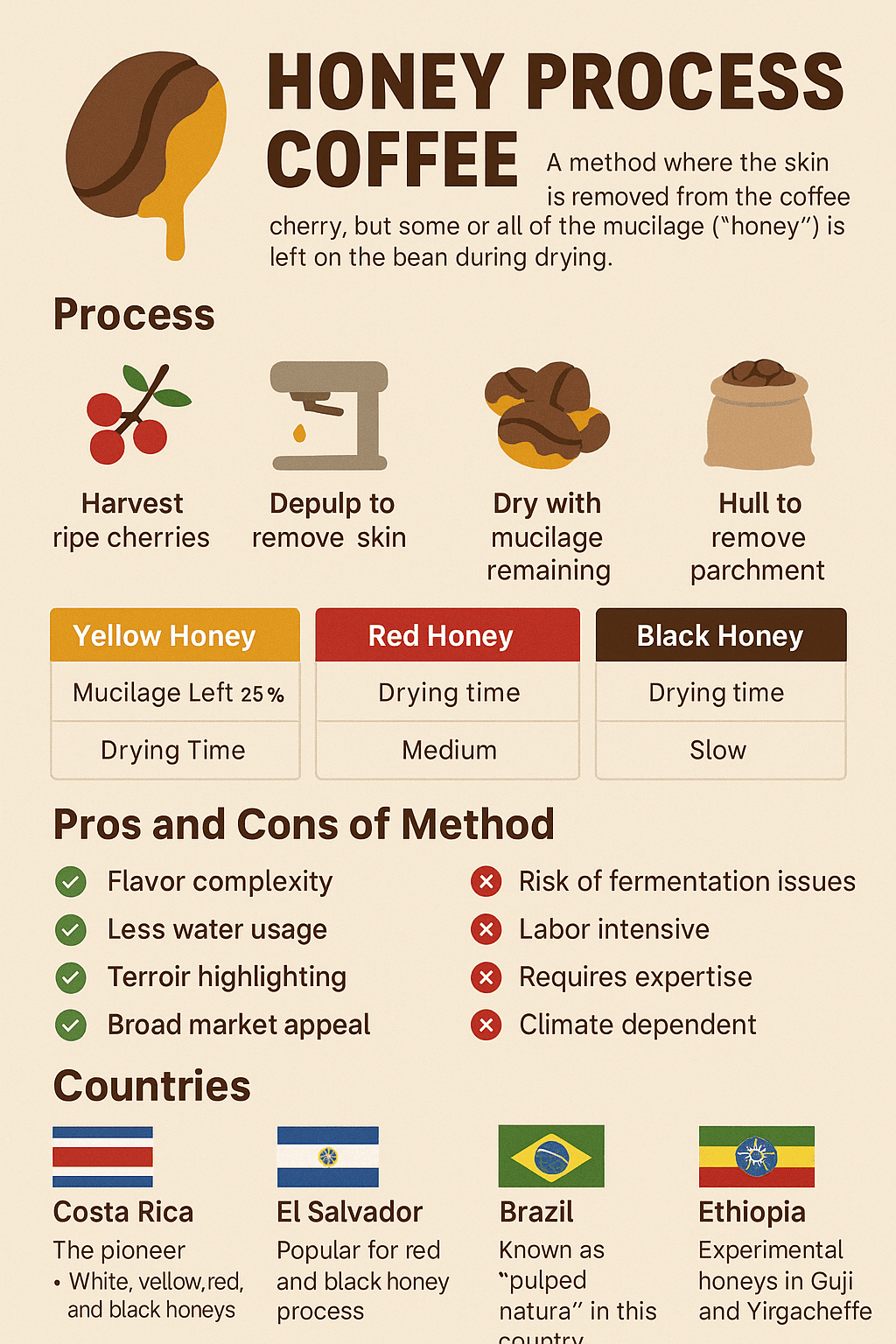
            When you hear “honey process coffee,” you might imagine bees, nectar, and sticky sweetness — but this coffee term has nothing to do with actual honey. Instead, it’s a reference to the sticky mucilage that clings to the coffee bean after depulping, giving rise to one of the most fascinating and flavorful processing methods in the specialty coffee world.


            What Is Honey Process Coffee?

            Honey process coffee is a hybrid technique that blends elements of both washed and natural processing. After harvesting ripe coffee cherries, producers remove the outer skin but intentionally leave a portion (or all) of the mucilage — the sugary layer — on the beans as they dry.

            This mucilage, often referred to as “honey” due to its sticky texture, ferments slightly during the drying phase, infusing the beans with complex flavors. The amount of mucilage retained and the speed of drying give rise to different categories: Yellow Honey, Red Honey, and Black Honey — each with a distinct flavor profile.

            Why It Matters: Flavor and Sustainability

            The honey process has become popular for its ability to produce coffee with vibrant fruit notes and balanced sweetness, combining the clarity of washed coffee with the body and complexity of naturals. But flavor isn’t the only benefit:

            • Water Conservation: Unlike fully washed methods, honey processing uses minimal water — a major plus in regions facing drought or resource scarcity.
            • Environmental Sensitivity: Less water means less pollution, making it an eco-friendlier option.
            • Taste Versatility: By adjusting mucilage levels and drying time, producers can fine-tune flavor profiles from clean and floral to syrupy and rich.

            Types of Honey Processing

            • Yellow Honey: Light mucilage left, quick drying, mild and bright.
            • Red Honey: Medium mucilage, moderate drying, more fruit-forward and sweet.
            • Black Honey: Full mucilage, slow drying, heavy body and deep sweetness.

            These variations allow producers to experiment and diversify their offerings, even from the same batch of cherries.

            Where It’s Thriving

            • Costa Rica is credited with pioneering and popularizing the honey process. Micro-mills like Las Lajas are known for their precision and consistency.
            • El Salvador produces stunning red and black honeys, especially from Pacamara and Bourbon varietals.
            • Brazil uses a variation called “pulped natural,” a large-scale method similar in principle but often more mechanized.
            • Ethiopia has also joined the honey movement, with some producers in Guji and Yirgacheffe offering experimental honey lots alongside their famed naturals and washed coffees.

            Brewing and Enjoying Honey Process Coffee

            Whether brewed as a pour-over or served as espresso, honey process coffees shine with layered complexity. They typically boast medium acidity, high sweetness, a silky body, and fruit-forward aromas — making them an excellent choice for curious coffee drinkers and connoisseurs alike.

            Final Thoughts

            Honey process coffee is more than just a method — it’s a craft. It requires precise control, climatic suitability, and careful drying. But when done well, the results are nothing short of extraordinary. As more coffee lovers discover this method, it continues to transform how we understand and appreciate the journey from cherry to cup.

            So next time you sip a cup of coffee with honey notes and velvety texture, remember — it may not contain honey, but it certainly carries the sweetness of thoughtful craftsmanship.


            Honey Process coffee