
Monsoon Malabar Coffee

Monsoon Malabar: India’s Unique Monsooned Coffee

Monsoon Malabar Coffee

If you’ve ever sipped a cup of coffee that feels mellow, earthy, and full-bodied without the sharp bite of acidity, chances are you’ve experienced Monsoon Malabar. This one-of-a-kind coffee from the Malabar coast of South India is famous worldwide for its distinct flavor, shaped by the natural forces of the monsoon.


The Monsooning Process

What makes Monsoon Malabar stand apart is its unusual post-harvest treatment known as “monsooning.” This traditional process transforms ordinary green coffee beans into something entirely unique.

  1. Exposing the beans – Freshly harvested raw beans are spread out in open-air warehouses along the Malabar coast.
  2. Monsoon conditions – For about three to four months, the beans are exposed to the damp, windy, and humid climate of the southwest monsoon season.
  3. Absorption and swelling – As the beans take in the moisture from the air, they swell to nearly twice their size.
  4. Flavor development – This prolonged exposure removes acidity while adding mellow, earthy, and smooth notes.
  5. Careful monitoring – Farmers rake and turn the beans constantly to ensure even moisture absorption and prevent mold, maintaining quality throughout the process.

The result is a coffee unlike any other in the world.

A Glimpse into History

The roots of Monsoon Malabar go back to the British Raj, when coffee beans were shipped from India to Europe in wooden vessels. The long sea voyages, often lasting months, exposed the beans to salty sea air and damp conditions. By the time they reached European shores, the beans had turned pale and mellow in flavor—a taste that became highly prized.

With the advent of faster cargo ships, this natural “monsooning” effect disappeared. To preserve the beloved flavor, farmers on the Malabar coast recreated these conditions on land, giving birth to the modern Monsoon Malabar process.

Tasting Notes

Monsoon Malabar is instantly recognizable in the cup:

  • Flavor: Mellow, earthy, and smooth, with subtle hints of caramel and bittersweet chocolate.
  • Acidity: Extremely low, making it gentle on the palate.
  • Body: Rich and heavy, with a satisfying depth.
  • Appearance: The beans turn a pale golden-yellow or straw color after the process.

Why Try Monsoon Malabar?

This coffee is perfect for those who love a smooth, low-acid brew with a bold body. It pairs beautifully with milk, making it ideal for lattes and cappuccinos, but it also shines when brewed black, highlighting its earthy, chocolatey notes.

Whether you’re a casual coffee drinker or a seasoned enthusiast, Monsoon Malabar offers a taste of India’s coffee heritage in every sip.

 

The Bold Beauty of Natural (Dry) Process Coffee

BY ARUN’S EXPERIMENTAL COFFEE LAB – Natural (Dry) Process Coffee

When it comes to coffee, the journey from cherry to cup is just as important as the origin or roast. One of the most traditional and striking methods in that journey is the natural process, also known as the dry process — a technique that can bring out deeply fruity, sweet, and complex flavors.


What Is Natural Process Coffee?

The natural process involves drying whole coffee cherries under the sun with the fruit still intact. Unlike washed or honey processes, no part of the cherry is removed before drying. Once the cherries are fully dried (usually over 2–4 weeks), the outer layers are mechanically hulled to reveal the green coffee bean inside.

This process is both ancient and effective — particularly in regions where water is scarce — and has become a signature method in places like Ethiopia, Brazil, and Yemen.

How It Works: Step-by-Step


      1. Harvesting: Only fully ripe cherries are picked for quality.

      1. Sorting & Cleaning: Defective or underripe cherries are removed.

      1. Drying: Whole cherries are spread out on raised beds, patios, or tarps.

      1. Monitoring: Cherries are turned several times daily to ensure even drying and prevent mold.

      1. Hulling: Once fully dried, the outer husks are removed.

      1. Resting & Roasting: Beans are rested, sorted, and roasted for consumption.

    Pros of the Natural Process


        • Intense Fruit Flavors: Berries, tropical fruit, and wine-like notes dominate.

        • High Sweetness & Body: Often syrupy and rich in texture.

        • Eco-Friendly: Requires minimal to no water.

        • Traditional & Accessible: Especially suitable for remote or arid regions.

      Challenges of the Natural Process


          • Risk of Fermentation or Mold: Requires careful control of drying conditions.

          • Inconsistent Batches: Can result in uneven flavors if drying is not uniform.

          • Labor Intensive: Needs constant attention and dry, sunny weather.

        Where It Thrives


            • Ethiopia: The birthplace of coffee, where naturals from Yirgacheffe, Guji, and Sidama are renowned for floral and berry-forward profiles.

            • Brazil: Utilizes large-scale sun drying and mechanical aids to produce balanced, nutty naturals.

            • Yemen: Ancient methods and heirloom varieties give rise to rich, winey, earthy naturals.

            • India: Known for robusta and arabica naturals from regions like Karnataka and Kerala.

          Brewing Natural Coffees

          Naturally processed coffees are versatile, but their bold character shines in methods like:


              • Espresso – Enhances syrupy body and ripe fruit notes.

              • French Press – Brings out sweetness and mouthfeel.

              • Pour-Over – Offers clarity with layered fruit.

            These coffees are a favorite among experimental roasters and curious drinkers.

            Final Thoughts

            The natural process is a beautiful intersection of tradition, climate, and craftsmanship. While it demands care and attention, it rewards with bold, memorable flavors that speak of the land and the labor behind each bean.

            Whether you’re sipping a sun-dried Sidamo or a pulpy natural from Brazil, you’re tasting coffee in one of its most raw and expressive forms — sweet, rich, and deeply connected to its origins.

            Unlocking the Sweet Science of Honey Process Coffee

            BY ARUN’S EXPERIMENTAL COFFEE LAB - ​ Science of Honey Process Coffee

            When you hear “honey process coffee,” you might imagine bees, nectar, and sticky sweetness — but this coffee term has nothing to do with actual honey. Instead, it’s a reference to the sticky mucilage that clings to the coffee bean after depulping, giving rise to one of the most fascinating and flavorful processing methods in the specialty coffee world.


            What Is Honey Process Coffee?

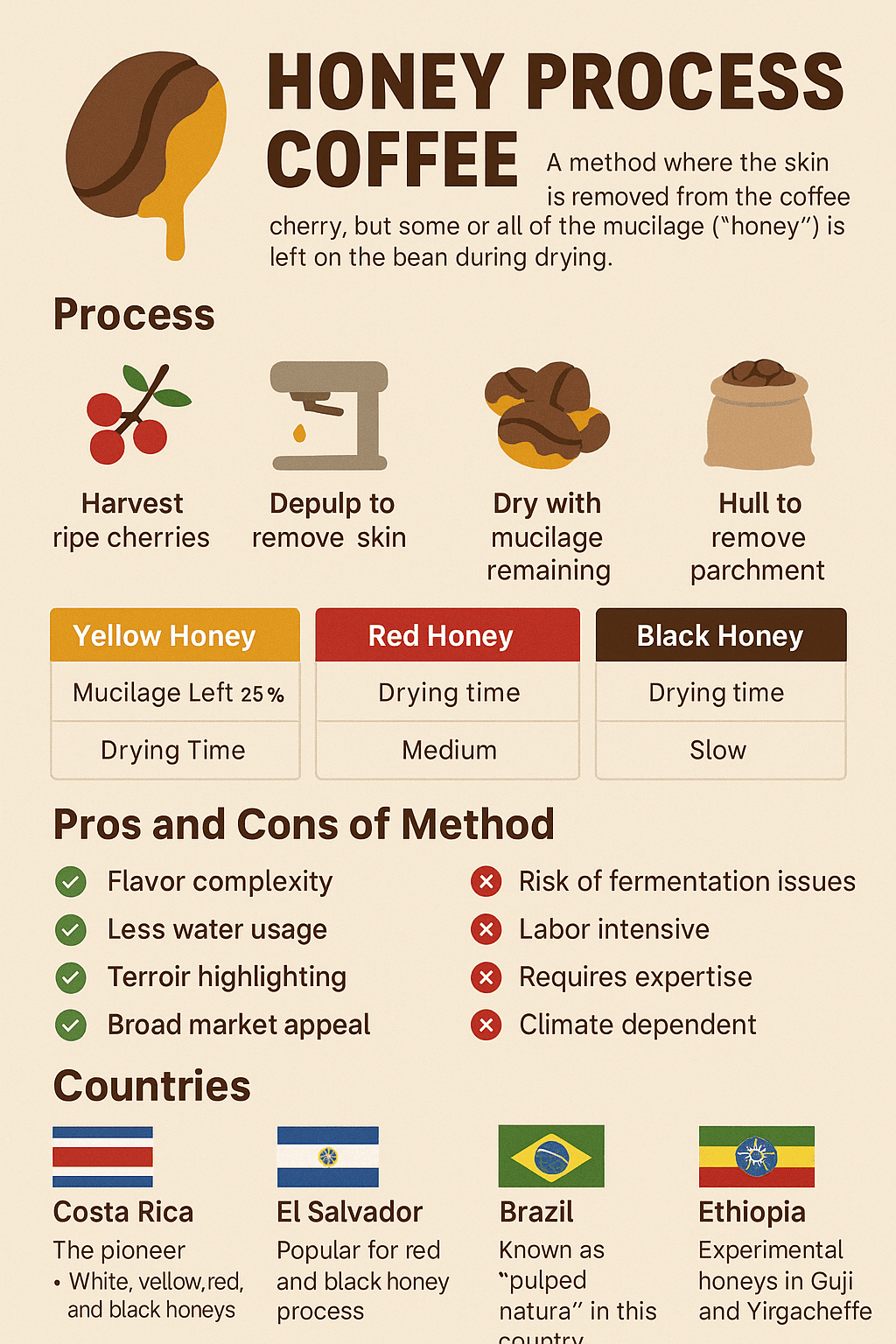
            Honey process coffee is a hybrid technique that blends elements of both washed and natural processing. After harvesting ripe coffee cherries, producers remove the outer skin but intentionally leave a portion (or all) of the mucilage — the sugary layer — on the beans as they dry.

            This mucilage, often referred to as “honey” due to its sticky texture, ferments slightly during the drying phase, infusing the beans with complex flavors. The amount of mucilage retained and the speed of drying give rise to different categories: Yellow Honey, Red Honey, and Black Honey — each with a distinct flavor profile.

            Why It Matters: Flavor and Sustainability

            The honey process has become popular for its ability to produce coffee with vibrant fruit notes and balanced sweetness, combining the clarity of washed coffee with the body and complexity of naturals. But flavor isn’t the only benefit:

            • Water Conservation: Unlike fully washed methods, honey processing uses minimal water — a major plus in regions facing drought or resource scarcity.
            • Environmental Sensitivity: Less water means less pollution, making it an eco-friendlier option.
            • Taste Versatility: By adjusting mucilage levels and drying time, producers can fine-tune flavor profiles from clean and floral to syrupy and rich.

            Types of Honey Processing

            • Yellow Honey: Light mucilage left, quick drying, mild and bright.
            • Red Honey: Medium mucilage, moderate drying, more fruit-forward and sweet.
            • Black Honey: Full mucilage, slow drying, heavy body and deep sweetness.

            These variations allow producers to experiment and diversify their offerings, even from the same batch of cherries.

            Where It’s Thriving

            • Costa Rica is credited with pioneering and popularizing the honey process. Micro-mills like Las Lajas are known for their precision and consistency.
            • El Salvador produces stunning red and black honeys, especially from Pacamara and Bourbon varietals.
            • Brazil uses a variation called “pulped natural,” a large-scale method similar in principle but often more mechanized.
            • Ethiopia has also joined the honey movement, with some producers in Guji and Yirgacheffe offering experimental honey lots alongside their famed naturals and washed coffees.

            Brewing and Enjoying Honey Process Coffee

            Whether brewed as a pour-over or served as espresso, honey process coffees shine with layered complexity. They typically boast medium acidity, high sweetness, a silky body, and fruit-forward aromas — making them an excellent choice for curious coffee drinkers and connoisseurs alike.

            Final Thoughts

            Honey process coffee is more than just a method — it’s a craft. It requires precise control, climatic suitability, and careful drying. But when done well, the results are nothing short of extraordinary. As more coffee lovers discover this method, it continues to transform how we understand and appreciate the journey from cherry to cup.

            So next time you sip a cup of coffee with honey notes and velvety texture, remember — it may not contain honey, but it certainly carries the sweetness of thoughtful craftsmanship.


            Honey Process coffee

            Kalimpong’s Coffee Awakening: Hidden Cafés and Himalayan Brews

            BY ARUN’S EXPERIMENTAL COFFEE LAB – Brewing Stories from the Eastern Himalayas

            Kalimpong — a serene hill town nestled in the Eastern Himalayas — has long been known for its orchids, British-era schools, and panoramic views of the Kanchenjunga. But in recent years, something new is quietly brewing in its winding lanes and colonial buildings: a vibrant coffee culture.

            At Arun’s Experimental Coffee Lab, we love tracing the roots of coffee across the hills. Today, we’re thrilled to shine a spotlight on Kalimpong, where local passion, cool mountain air, and creative brewing are transforming it into a coffee lover’s hidden gem.


            🌱 The Birth of Kalimpong’s Coffee Culture

            Unlike the long-established plantations in South India or Nepal’s Arabica estates, Kalimpong’s coffee journey is still young. A few pioneering locals, inspired by global coffee trends and the ideal climate (cool temperatures, high altitude, shaded slopes), began experimenting with growing Arabica beans and serving specialty coffee in small cafés.

            The results? Promising beans, enthusiastic roasters, and a café scene that’s growing more flavorful by the day.


            📍 Cafés Worth Visiting in Kalimpong

            Here are some of our favorite spots where coffee is served with heart, views, and stories:

            1. The Art Café

            • Nestled on a quiet hill, this cozy space serves French press and pour-over brews alongside fresh pastries and art.
            • Ambience: Peaceful, creative, and homey

            2. Café Kalimpong

            • Locally run café supporting regional artists and musicians.
            • Coffee is sourced from nearby Darjeeling and Kalimpong hills.

            3. Coffee House by Parijat

            • Minimalist, modern café with great coffee and scenic seating.
            • Known for: V60 pour-over and chocolate cake

            4. Gallery 9 Café

            • A blend of art gallery and café; often features local photography and coffee from small farms.
            • Espresso and cold brew options are top-notch.

            5. The Hangout Café

            • A younger crowd, energetic vibe, and strong lattes.
            • Great spot for digital nomads and casual meetups.

            🌿 Local Coffee Growing & Roasting

            Kalimpong’s altitude (1,200–1,800 meters) and shaded slopes make it ideal for Arabica cultivation. While large-scale plantations are still rare, a few small farms and enthusiasts have started experimenting with:

            • Shade-grown Arabica
            • Natural and honey-processed beans
            • Sun-drying on bamboo trays

            These micro-lots are slowly entering the local market, roasted in small batches by passionate brewers who want to keep the flavor close to the terroir.


            🔥 Coffee Workshops & Tastings

            Some cafés in Kalimpong, like The Art Café and Gallery 9, are beginning to host:

            • Brewing technique sessions (V60, Aeropress, French press)
            • Latte art demos
            • Cupping events with local beans

            It’s a community effort — and a great way to get hands-on with the Himalayan bean scene.


            🌍 Why Kalimpong Deserves a Spot on the Coffee Map

            • Untapped potential: With climate, soil, and altitude aligned, Kalimpong could become a future hub for specialty Indian coffee.
            • Unique cultural blend: The café scene blends Gorkha, Tibetan, British, and Nepali influences.
            • Sustainable growth: Most cafés use local ingredients and support fair sourcing.

            ☕ Café Lantern’s Take

            As a café dedicated to showcasing rich, authentic coffee stories, Café Lantern is inspired by Kalimpong’s grassroots coffee movement. We believe in supporting regional efforts and hope to feature Kalimpong-grown beans in future tasting events and collaborations.

            If you’re ever on a coffee trail across the Himalayas, add Kalimpong to your route. It may just become your new favorite stop — and we’d love to bring a piece of it to your cup here at Café Lantern.


            Arun’s Experimental Coffee LabLighting the path of coffee across the Himalayas, one story at a time.

            Discovering Nepal’s Coffee Culture: From Plantations to Cafés

            BY ARUN’S EXPERIMENTAL COFFEE LAB – Where Every Brew Tells a Story

            Nestled in the lap of the Himalayas, Nepal is more than just mountains, monasteries, and majestic landscapes. Over the past few decades, it has quietly been building a name for itself in the world of specialty coffee. From high-altitude plantations to artisanal roasters and cozy coffee shops in bustling towns, Nepal’s coffee scene is rich, evolving, and absolutely worth exploring. In this post, we’ll take you through the history of coffee in Nepal, the best coffee-growing regions, processing methods, roasters, and must-visit cafés.

            A Brief History of Coffee in Nepal

            Coffee was first introduced to Nepal in 1938 when a monk brought some seeds from Burma (now Myanmar) and planted them in the Aapchaur village of Gulmi District in western Nepal. For several decades, coffee remained a backyard crop, grown in small quantities mostly for personal consumption.

            It wasn’t until the 1980s that Nepal started to explore the commercial potential of coffee. With the support of international aid organizations and NGOs, coffee farming began to take shape as a livelihood option for farmers in the mid-hill regions of Nepal. Today, Nepalese coffee is recognized globally for its smooth body, low acidity, and floral and fruity notes, thanks to the high altitudes, organic cultivation, and unique terroir.

            🌄 Best Coffee Plantations and Estates in Nepal

            1. Gulmi District (Aapchaur)
              • The birthplace of Nepalese coffee, Gulmi remains one of the top producers. The region benefits from fertile soil and high elevation (1,200–1,800m), making it ideal for Arabica coffee.
            2. Syangja
              • Located in the Western Development Region, Syangja is known for its well-established coffee cooperatives. The coffee here is typically shade-grown and organically cultivated.
            3. Lalitpur (Nallu, Godawari)
              • Close to Kathmandu, this area has seen a rise in boutique coffee farms. The advantage here is quick access to roasters and urban markets.
            4. Kavre
              • Another emerging hub, with many smallholder farmers adopting specialty-grade processing techniques. Kavre is close to the capital and has a growing number of micro-lots with excellent quality.
            5. Palpa and Arghakhanchi
              • These mid-western regions are gaining attention for their consistent climate and quality beans. Several estates here work with international buyers for export.

            🔄 Coffee Processing Methods in Nepal

            Nepal primarily uses three main processing methods:

            • Washed (Wet) Process – The most common method, especially for export-quality beans. It produces a clean cup with distinct acidity.
            • Honey Process – Growing in popularity, especially among artisanal producers. This method gives the coffee a sweeter and fuller body.
            • Natural (Dry) Process – Rare but used in some areas. This method imparts fruity, wine-like notes to the coffee.

            Many producers also sun-dry their beans on raised beds, which improves airflow and helps maintain quality.

            🔥 Noteworthy Coffee Roasters in Nepal

            1. Himalayan Java Roasters
              • Perhaps Nepal’s most famous roaster and café chain, they also export beans and work closely with farmers.
            2. Kar.ma Coffee
              • A boutique roaster known for sustainable practices and working directly with farmers. Their roastery and café in Lalitpur is a must-visit.
            3. Lekali Coffee Estate
              • Lekali grows and roasts its own beans from its estate in Nuwakot. They focus on traceability and specialty-grade coffee.
            4. Nepal Coffee Company
              • One of the pioneers in Nepal’s specialty coffee industry, they offer single-origin beans and work with co-ops across the country.
            5. Greenland Organic Farm
              • A premium producer and exporter with their own roasting facility. Their beans are grown in Lamjung and are available in select outlets in Kathmandu.

            ☕ Best Coffee Shops in Nepal

            1. Himalayan Java (multiple locations)
              • The Starbucks of Nepal – reliable quality, great ambiance, and widely loved.
            2. Café Soma (Lalitpur)
              • A relaxed vibe with great coffee and baked goods.
            3. Kar.ma Coffee @ Patan
              • A quiet spot to enjoy thoughtfully brewed coffee and learn about the sourcing behind each cup.
            4. Flock Café (Kathmandu)
              • Known for creative brews and cozy ambiance.
            5. Coffee Pasal (Pokhara)
              • Excellent pour-overs and a great view of Phewa Lake.

            🌱 The Future of Nepalese Coffee

            Nepal’s coffee industry is still young but shows immense promise. With more farmers turning to organic and sustainable practices, and with increasing support for specialty processing and direct trade, Nepal is poised to make a bigger impact on the global coffee map. As domestic demand also grows, new roasters, cafés, and coffee lovers are creating a vibrant, passionate community.

            Whether you’re a traveler, a barista, or simply a coffee enthusiast, Nepal’s coffee culture offers a unique and enriching experience—from the soil to the cup.

            Final Thoughts

            Nepal’s coffee journey is one of resilience, passion, and high-altitude perfection. The blend of traditional farming, innovative processing, and a deep respect for nature results in a cup of coffee that’s not only delicious but meaningful.